

New wastewater technologies are giving rural homeowners more options when conventional septic systems don’t fit
For someone buying or owning a rural residential lot, there is a moment that can turn excitement into disappointment: the septic evaluation.
The house fits the lot. The road is there. There is water nearby. The zoning allows a home.
Then the septic designer looks at the soils, slope, groundwater, setbacks and available space and delivers the bad news.
The problem isn’t necessarily the house.
It is where the wastewater is going to go.
For decades, the basic solution for a rural home has been straightforward: wastewater goes into a septic tank, solids settle, and the liquid moves into a drainfield where the soil provides additional treatment and dispersal.
When a lot has plenty of suitable soil and room for a drainfield, this works extremely well.
But many rural residential lots don’t have that luxury.
A lot may have shallow or poorly draining soils. Groundwater may be too close to the surface. A river, creek, well, property line or steep slope may eliminate much of the usable area. And even when there is enough suitable soil, there may not be enough room for both a primary drainfield and the required replacement area.
Suddenly, a lot that looks perfectly capable of supporting a house may not have an obvious place for a conventional septic system.
That is where wastewater technology is beginning to get more interesting.
Building in Rural Septic Resource links below

The Septic Test That Can Kill a Building Project
The problem with a difficult septic site isn’t always that there is nowhere for wastewater to go.
Sometimes there simply isn’t enough suitable land to use the traditional way.
Oregon recognizes a category of systems called Alternative Treatment Technologies, or ATTs. These systems improve wastewater quality before it reaches the drainfield, potentially allowing different approaches to treatment and dispersal. Oregon requires ongoing operation and maintenance contracts for approved ATT systems.
That distinction matters.
Advanced treatment does not mean the homeowner gets to ignore the soil.
It means the wastewater can receive more treatment before it reaches the soil, giving a designer another set of tools to work with.
And on a small residential lot, those tools can make a substantial difference.
The Real Problem Isn’t the Tank. It’s the Drainfield.
It is tempting to think of the septic tank as the septic system.
For a difficult lot, however, the tank is often not the problem.
The bigger challenge is what happens after the wastewater leaves the tank.
The soil has to accept the treated wastewater and provide additional treatment as it moves through the ground. The amount, quality and location of suitable soil can determine whether a home can be built.
That is why a conventional septic design can consume a surprisingly large portion of a residential property.
The homeowner isn’t just looking for somewhere to put a tank.
They’re looking for a place to put the wastewater, plus whatever additional area is required for the system to operate and be replaced if necessary.
Once you understand that, some of the newer technologies begin to make more sense.
What If You Don’t Have Enough Room for a Conventional Drainfield?
This is where the conversation gets more interesting.
Instead of asking only:
“Can I fit a conventional drainfield here?”
a designer can ask:
“How can I treat the wastewater more effectively and make the best use of the suitable soil I actually have?”
That is the philosophy behind several advanced wastewater approaches.
Some are already established and approved for use in Oregon.
Others are newer technologies that could eventually change what is possible on constrained residential lots.
AeroCell: A Different Way to Approach a Difficult Lot
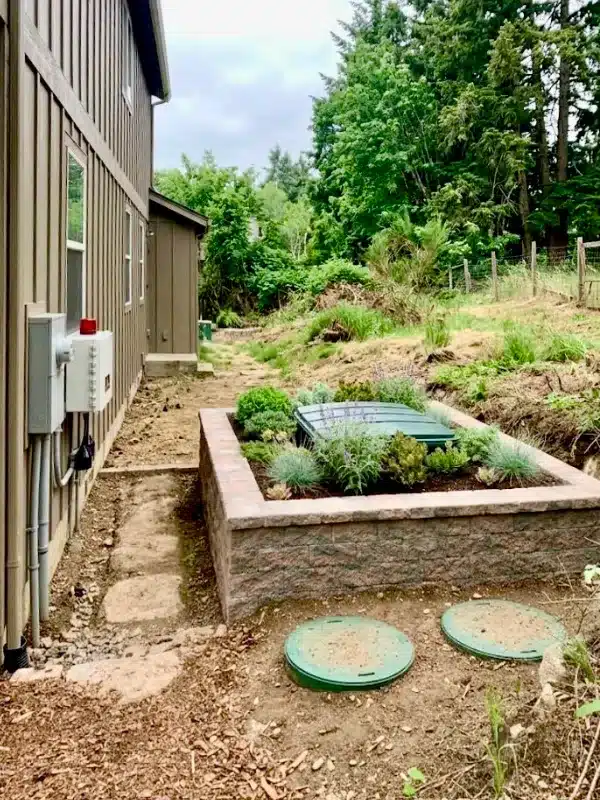
One of the technologies worth watching is AeroCell, developed by Anua.
AeroCell uses a media-based biological treatment process in a modular treatment unit. Anua describes the system as suitable for single-family homes as well as larger decentralized applications. The company also markets a pad-dispersal approach in which treated wastewater is pressure-dosed through the dispersal area.
The interesting part for a small residential property is not simply the treatment equipment.
It is the combination of treatment and dispersal.
Rather than trying to force a large conventional gravity drainfield onto a property where space or soil conditions are limited, a designer may be able to make better use of the portion of the site that actually has suitable soil.
That doesn’t mean AeroCell makes an unbuildable property automatically buildable.
It doesn’t eliminate soil evaluation, setbacks or regulatory requirements.
And homeowners in Oregon should not assume that a technology approved in another state is automatically approved here. AeroCell does not appear on Oregon DEQ’s current published list of approved Alternative Treatment Technologies, so its availability for a particular Oregon residential application needs to be confirmed with the designer and the appropriate regulatory authority. Oregon does maintain a separate approval process for new or innovative onsite technologies.
Alex Sundberg, Anua’s Business Development & Technical Manager based in Oregon, said the company is working on getting on the Oregon list and eager to work with Oregon property owners in get projects approved.
That caveat aside, AeroCell represents an important shift in thinking.
The question becomes less about squeezing a traditional septic design onto the property and more about designing the wastewater system around the property.
For a homeowner with a difficult lot, that’s an important distinction.
Orenco: An Oregon-Proven Advanced Treatment Option
AeroCell isn’t the only technology changing the equation.
Oregon-based Orenco Systems has been developing advanced onsite wastewater systems for decades. Its AdvanTex systems use textile media for biological treatment before wastewater proceeds to dispersal.
More importantly for an Oregon homeowner, Orenco’s AdvanTex systems are currently included on Oregon DEQ’s approved Alternative Treatment Technology list. DEQ lists several residential-scale AdvanTex configurations, including systems from 500 gallons per day upward.
That makes Orenco particularly relevant to a homeowner who wants to explore advanced treatment today, rather than waiting for an emerging technology to complete the regulatory process.
Again, the technology doesn’t eliminate the need for appropriate dispersal.
But it gives the designer another tool.
And sometimes the difference between a property that works and one that doesn’t is not the treatment tank itself. It is whether the designer has enough flexibility to make the entire treatment and dispersal system work within the site’s constraints.
Then Comes the Wild Card: Honu Hub
If systems such as AdvanTex and AeroCell represent an evolution of today’s onsite wastewater technology, Honu Hub represents a potentially more radical direction.
Honu Hub is being developed by an interdisciplinary research team involving the University of South Florida, University of Hawaiʻi and environmental technology partners.
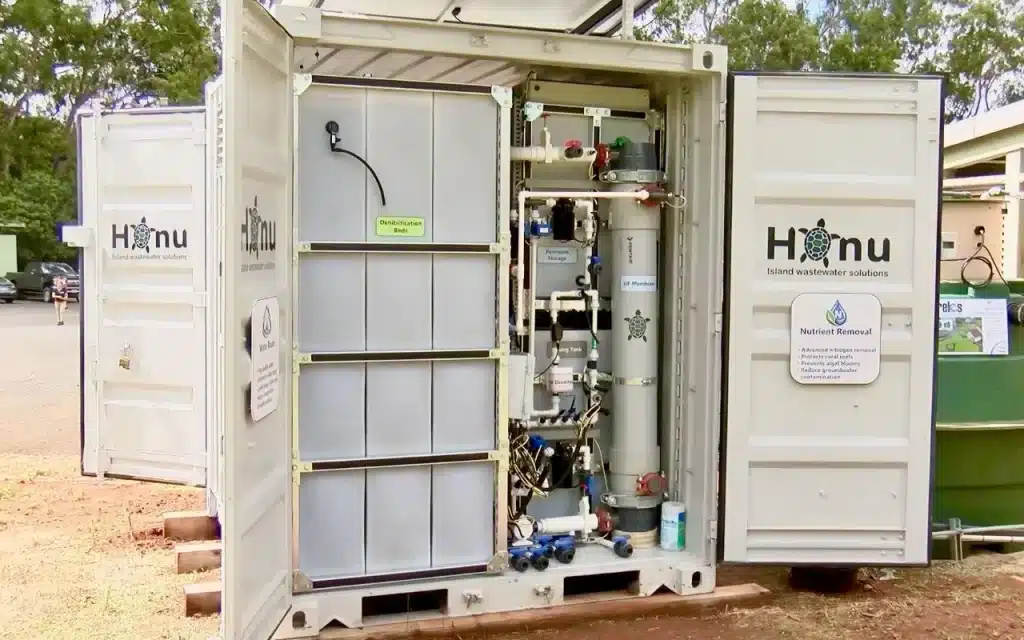
The system is designed specifically for decentralized wastewater applications serving individual homes and small clusters. Honu describes the technology as using advanced membrane filtration, water recycling, remote monitoring and renewable energy to create a more compact decentralized wastewater system.
For a homeowner with a tiny or highly constrained lot, that raises an intriguing possibility:
What if much more of the wastewater treatment could happen inside the treatment equipment itself?
Instead of spreading the wastewater treatment function across a large portion of the property, the treatment system could occupy a much smaller footprint.
There are potentially additional benefits, including nutrient removal, water recycling and energy independence. But Honu Hub remains an emerging technology. It is not currently an Oregon-approved replacement for a conventional residential septic system.
That makes Honu Hub less useful as a solution for someone who needs a permit tomorrow, but extremely interesting as a glimpse of where decentralized wastewater treatment may be headed.
Could the Future of Septic Fit in a Garden Shed?
That is one of the most intriguing questions raised by technologies such as Honu Hub.
Traditional onsite wastewater systems spread the job across the property: a tank, pipes, pumps and a substantial area of soil.
Newer systems are trying to concentrate more of the treatment into the equipment.
That could become increasingly important as communities try to add housing on smaller parcels without extending municipal sewer systems.
But there is a critical distinction between making treatment smaller and eliminating the need for dispersal.
Wastewater still has to go somewhere.
A homeowner still needs a legal and environmentally appropriate way to deal with the treated water.
The technology may change. The engineering requirements do not disappear.
Three Generations of Thinking About a Difficult Lot
For homeowners, these technologies can be thought of as three broad generations of wastewater design.
Generation One: Conventional Septic
Treat wastewater in a septic tank and use a conventional soil dispersal system.
When a property has adequate soil, space and favorable site conditions, this remains the simplest and often least expensive solution.
Generation Two: Advanced Treatment
Use more sophisticated treatment before dispersal, potentially combined with pressure distribution, pad dispersal or another approved approach.
Orenco’s AdvanTex is an example of a technology that is already approved in Oregon.
AeroCell represents another interesting approach to advanced treatment and alternative dispersal, although Oregon homeowners need to verify its regulatory status for their specific application.
Generation Three: Highly Compact Decentralized Treatment
Move much more of the treatment into a compact system and potentially reduce the amount of land devoted to wastewater infrastructure.
Honu Hub represents this emerging direction.
It is not yet an Oregon-ready residential solution, but it points toward a future in which wastewater treatment could occupy dramatically less land.
Your Septic Designer May Matter as Much as the Technology
There is another piece of the puzzle that homeowners don’t always consider.
You can have access to advanced wastewater technology and still never hear about it.
A septic designer who works primarily with conventional systems may naturally start with the systems they know best. That isn’t necessarily a problem. Familiar systems have advantages, and sometimes conventional septic really is the best answer.
But on a difficult property, it is reasonable to ask whether the designer has considered alternatives.
Instead of asking only:
“Can you design a septic system for my property?”
a homeowner might ask:
“If a conventional septic system doesn’t work, what alternative treatment and dispersal technologies would you consider?”
That question can tell you a lot.
A homeowner may want to find a wastewater professional who has experience with difficult residential sites, pressure distribution and alternative treatment technologies.
And it is perfectly reasonable to get a second opinion.
The goal isn’t to find someone who promises to make the property work.
The goal is to find someone willing to determine whether it can work.
We’ve prepared a separate guide for homeowners on how to find and evaluate a septic designer when the conventional answer isn’t working.
See: “Your Septic Designer Says No. Should You Get a Second Opinion?”
Before You Give Up on the Property, Ask These Questions
A conventional septic failure does not automatically mean a property cannot be developed.
But neither does an advanced treatment system automatically solve the problem.
Before giving up, a homeowner should understand exactly why the conventional system failed.
Was it:
- insufficient usable soil?
- shallow or restrictive soils?
- high groundwater?
- steep slope?
- required setbacks?
- inadequate room for a replacement area?
- excessive wastewater loading?
- or simply the footprint and configuration of a conventional gravity drainfield?
Those answers matter because different technologies solve different problems.
A site with enough suitable soil but insufficient room for a conventional gravity system may have very different possibilities from a property with almost no acceptable soil.
That is why the most useful question may not be:
“What is the cheapest septic system?”
It may be:
“What is the least expensive wastewater system that can legally and reliably work on this particular lot?”
Those are two very different questions.
The Bigger Opportunity: More Homes on Land We Already Have
This matters beyond septic engineering.
In rural communities, there are residential parcels that sit vacant because conventional infrastructure doesn’t fit easily.
Some are too small.
Others have difficult soils, steep terrain, groundwater or environmental setbacks.
Some were created decades ago under assumptions about septic systems that don’t match today’s requirements.
When those properties remain vacant, the community loses potential housing without necessarily having a shortage of land.
The infrastructure is the bottleneck.
If advanced treatment can reduce the land required for wastewater infrastructure, some of those properties may become viable.
That doesn’t mean every difficult lot becomes developable.
It means the definition of a difficult lot may begin to change.
The Future of Septic May Be Much Smaller
Rural wastewater infrastructure has traditionally followed a fairly simple philosophy: find enough land, install a sufficiently large drainfield and let the soil do the work.
That works beautifully when land is plentiful and site conditions cooperate.
But smaller residential parcels create a different challenge.
The next generation of decentralized wastewater systems may approach the problem differently.
Treat more wastewater before it reaches the soil.
Use pressure rather than gravity.
Use the best soil available instead of requiring a large conventional drainfield.
And eventually, perhaps recover and reuse more of the water and nutrients rather than treating wastewater as something that simply needs to disappear underground.
For a homeowner with a difficult residential lot, that future is not here yet.
But pieces of it are already arriving.
And that means a disappointing septic evaluation may not necessarily be the final chapter.
It may simply be the point where it becomes necessary to ask a better question.
Want to Explore the Technology?
The companies below can provide additional information about their systems. A manufacturer can explain what its technology is designed to do, but the homeowner still needs an Oregon-qualified wastewater professional to determine whether a particular system is appropriate and permitted for the site.
Orenco Systems
AdvanTex® Advanced Treatment Systems
Orenco is headquartered in Sutherlin, Oregon. Its AdvanTex systems are among the alternative treatment technologies currently approved by Oregon DEQ.
Phone: 800-348-9843
Local: 541-459-4449
Website: Orenco.com
Anua
AeroCell® Advanced Wastewater Treatment
Anua’s AeroCell system is marketed for single-family homes and other decentralized applications. Anua provides technical information, consultations and a locator for authorized service providers and distributors.
Phone: 775-881-8320 Alex Sundberg
Website: AnuaInternational.com
Homeowners can specifically ask Anua about AeroCell, residential applications, Oregon availability and local designers/installers.
Honu Water
Honu Hub™
Honu Hub is an emerging decentralized wastewater technology designed for individual homes and small clusters. The system is still in development and evaluation, so homeowners should view Honu primarily as a technology to watch rather than an immediately available Oregon septic solution.
Website: HonuWater.com
Oregon Department of Environmental Quality
Approved Alternative Treatment Technologies
Oregon DEQ maintains the state’s current list of approved Alternative Treatment Technologies and provides information about approval of new or innovative onsite wastewater technologies.
Website: Oregon.gov/DEQ
For homeowners, this is an important reality check. A technology may be technically impressive, commercially available or approved somewhere else and still require additional approval before it can be used on an Oregon residential property.