

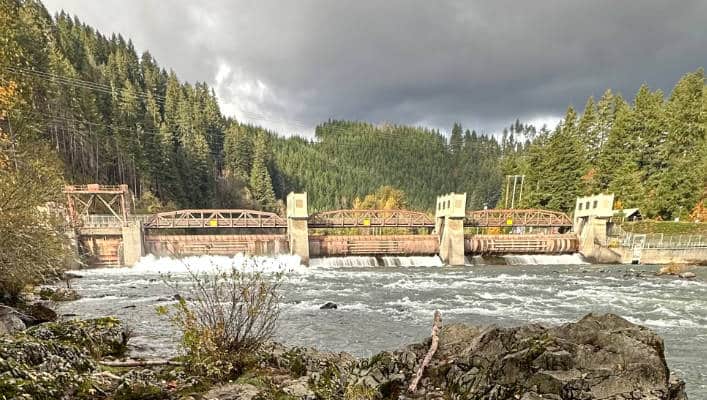
We did a larger article on Decommissioning Leaburg Dam back in November 2023. Some have expressed concerns or over the numbers and methods EWEB has used in determining its decision to shut down the Leaburg Dam and its hydro facility. Here are the short answers as to why the dam is going away.
Key Reasons for Decommissioning
1. Economic Non-Viability
- After a thorough “Triple Bottom Line” evaluation (weighing financial, environmental, and social factors), EWEB determined that reopening and operating the Leaburg Hydroelectric Project would necessitate producing electricity at an estimated $117 per megawatt-hour, significantly more expensive than alternative power sources—namely, power from the Bonneville Power Administration (BPA) costing around $33/MWh mckenziecommunity.org EWEB.
- Continuing operations would thus lock customers into high electricity costs for decades, whereas purchasing cheaper power represents a far more affordable alternative EWEB kezi.com.
2. Structural and Regulatory Risks
- The canal used to divert water from the McKenzie River was shut down in 2018 by federal regulators due to seepage, internal erosion, and lack of seismic resilience in the nearly 100-year-old infrastructure kezi.com McKenzie River Reflections opb.
- Restoring the project to current safety and regulatory standards would involve prohibitively high costs and considerable risk.
3. Liability and Future Uncertainties
- Decommissioning reduces EWEB’s exposure to financial and operational liabilities, especially in light of climate change, shifting regulations, and long-term uncertainty around hydropower generation viability EWEB.
4. Environmental & Community Alignment
- Removing the dam restores the McKenzie River to a free-flowing state, which supports improved fish passage (notably for salmon), and protects water quality—aligning with community environmental values and public sentiment opb EWEB McKenzie River Reflections.
- The decision also reflects EWEB’s mission to avoid long-term, non-core obligations and focus on reliable, cost-effective service EWEB.
What’s the Decommissioning Plan & Timeline?
- 2023: EWEB commissioners unanimously approved the decommissioning decision and began developing a detailed Leaburg Decommissioning Action Plan (LDAP) EWEB McKenzie River Reflections.
- 2023–2027: Implementation of near-term risk-reduction measures, and preparation for license surrender, impact assessments, and stakeholder engagement EWEB.
- 2028–2029: Environmental studies—including Endangered Species Act consultations and NEPA (National Environmental Policy Act) analysis—will be conducted EWEB.
- 2030–2032: Design, permitting, and securing the FERC Surrender Order EWEB mckenziecommunity.org.
- 2033–2040: Physical decommissioning and post-project reporting EWEB.
- EWEB expects deconstruction or dam removal to start no earlier than 2032, following thorough approvals and studies opb KLCC mckenziecommunity.org McKenzie River Reflections.
Interim Support & Planning
- In December 2024, EWEB signed a $18.5 million, 10-year contract with McMillen Inc. to guide engineering, outreach, and regulatory preparation (not the actual physical removal) KLCC.
- The total estimated cost for the removal and associated work ranges from $160 million to $200 million, with planned modest rate increases and pursuit of external funding to mitigate customer impact EWEB KLCC.
Community Voices
Local Reddit discussions echo similar concerns: one user noted the high cost comparison:
“EWEB calculated the cost of energy to restore generation at Leaburg would produce electricity at $117/MWh… considering recent wholesale electricity … prices are around $23/MWh, they would have to make the repairs … for 1/5 the estimated cost for it to make sense.” Reddit
Others expressed hope for restoration, while some highlighted ecological benefits:
“Drain it and put in a whitewater park. You still get tourism/recreational value and fish passage. … Its removal would also be great for salmon and fly-fishing.”
Important Notes:
Is it a Done Deal? A local group of Leaburg Lake residents and other interested parties have created a group called Oregon Citizens for Energy Security with the intention of helping to save the lake. Follow the link to learn more.
MCP’s position on Removing or Keeping the Dam: McKenzie Community Partnership nor Chris LaVoie, the author has taken a side on the issue. we recognize that both improving Salmon health and the recreation benefits of the lake have merits. We want to help educate and promote understanding of the issues to help us reach teh right decision. Hopefully we can find a win – win in the end.