Skip to content
Fire-Ready Homes

Keep your home safe and insurable

Plain-language steps that make your home far more likely to survive a wildfire and give you a stronger case with insurers. Start with what’s free and cheap.

Start here

What brought you here?

Pick the one that fits. Each path ends with one clear next step.

I got an insurance notice

A nonrenewal, a cancellation or a big wildfire-related rate jump. Here's what to ask, what to fix first and who helps for free.

Keep your insurance

I want to lower my risk

A ranked list of what actually keeps a house from burning, cheapest and most effective first. Most of step one is a weekend of work.

See the 7 steps

I need help paying for it

Which grants and free inspections are open right now, how to avoid reimbursement traps, and how to find help anywhere.

Find help

The checklist

Seven steps, in the order that matters

Embers start most home fires in a wildfire, so the list starts where embers land. The early steps are the cheapest and count the most with fire experts and insurers. Based on IBHS Wildfire Prepared Home and Oregon State Fire Marshal guidance.

  1. 1

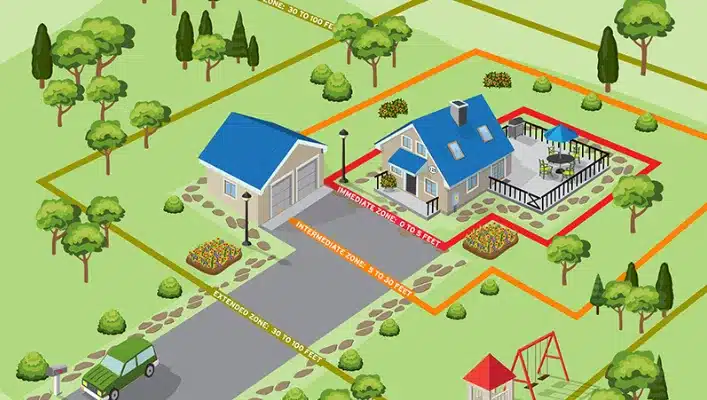
    The first 5 feet around the house

    Replace bark mulch with rock, move plants and woodpiles away, clear needles and debris, and swap the last 5 feet of fence for metal.

    DIYFree to $$Insurers look here first
  2. 2

    Roof and gutters

    Keep the roof and gutters clear of needles and moss, trim branches back from the roof, and choose a Class A roof when you replace it.

    DIY to contractorFree to $$$Insurers rate roof type
    Guide coming soon
  3. 3

    Vents

    Cover foundation, eave and gable vents with 1/8-inch metal mesh, or upgrade to ember-resistant vents.

    Often DIY$Insurers recognize it
    Guide coming soon
  4. 4

    Decks, siding and fences

    Empty the space under the deck, enclose low decks, and keep 6 inches of noncombustible material at the base of the walls.

    DIY to contractor$ to $$$
    Guide coming soon
  5. 5

    5 to 30 feet

    Limb trees up, remove shrubs under trees, and space plants so fire can’t climb or spread.

    DIY or hireFree to $$
  6. 6

    30 to 100 feet

    Remove dead trees and brush, thin small trees, and chip or haul slash instead of piling it.

    Hire or chipper day$$ to $$$
    Guide coming soon
  7. 7

    Access for fire engines

    A visible address sign, a clear driveway and room for an engine to turn around. Crews defend homes they can reach.

    DIY to contractorFree to $$
    Guide coming soon

Costs are rough estimates: $ under $200, $$ $200–$1,000, $$$ over $1,000. Print the checklist and photo log →

Free help, open now

Three calls worth making

Free home inspection

541-896-3311

McKenzie Fire & Rescue checks driveway access and the first 50 feet, and gives you a list.

Insurance problem

888-877-4894

Oregon Division of Financial Regulation consumer advocates help with nonrenewals and complaints.

Statewide assessment

Request online

The Oregon State Fire Marshal offers free defensible space visits anywhere in Oregon.

Straight talk

What this work can and can’t do

This work makes your home much more likely to survive a wildfire. That part is backed by research.

It doesn’t guarantee a lower premium. Insurers use their own risk models and set their own discounts. Doing the work and documenting it gives you the strongest possible case.

MCP doesn’t sell anything. We explain your options and connect you with the agencies and experts who can help.

For other communities

Use this in your town

Most of this applies anywhere in the Cascades and the rural West. The checklist, photo log and guides are free to copy and adapt; please credit McKenzie Community Partnership. Tell us how you’re using it.

Questions

Quick answers

Does fire-safety work lower my home insurance?

It can. Oregon insurers must consider defensible space and home hardening, but each company decides its own discounts. The work reliably makes your home more likely to survive; a lower premium is a possible bonus.

What should I do first?

Clear everything that can burn from the first 5 feet around your house. Embers cause up to 90 percent of home ignitions in wildfires, and this step costs little or nothing.

Is this the Firewise program?

No. We use proven tools from Firewise USA, IBHS and the Oregon State Fire Marshal, but this is MCP’s homeowner program. Neighborhoods that want official Firewise USA recognition can still pursue it.

Can other communities use this?

Yes. The checklist, photo log and guides are free to copy and adapt. Please credit McKenzie Community Partnership.