

Short answer
Three Sisters Meadow is more likely to succeed as a recreation and wellness destination if the town around it grows too. Visitors need places to eat and shop, and workers need homes nearby. Blue River has three Flex-zoned areas with different strengths: a walkable downtown, larger highway-frontage sites at Blue River West, and the meadow itself. Planning them to complement each other, with housing in all three and practical wastewater solutions, gives each a better chance. It doesn’t require common ownership or a single developer.
Last reviewed November 18, 2026 by McKenzie Community Partnership. Applies to Blue River, Oregon, and to any rural town planning a destination project. Part 3 of the Blue River housing series.
Executive summary
Three Sisters Meadow could become a distinctive recreation, health and wellness destination for the McKenzie River communities. Its connection to the community track, outdoor recreation, possible lodging and integrated housing could create something special for Blue River and the region.
But its success is closely tied to what happens beyond its boundaries. A destination needs employees who can afford to live nearby, restaurants and businesses that serve visitors, everyday goods and services close at hand, and a community that gives people reasons to visit, stay and return.
Blue River has three complementary development areas that could make this possible:
- Downtown Blue River: many smaller properties suited to walkable housing, restaurants, retail and community services.
- Blue River West: about 9 acres of Flex-zoned land with highway frontage and access, larger sites, and room for commercial anchors, lodging and housing.
- Three Sisters Meadow: a 16-acre community asset with potential for recreation, health and wellness, hospitality, integrated housing and limited wastewater infrastructure.
Each has different advantages. The opportunity is to develop them so they complement one another rather than compete for the same uses. That doesn’t require common ownership, a single developer or a formal agreement. It requires recognizing that their economic futures are connected.
The central idea is simple: Three Sisters Meadow doesn’t need to develop all of Blue River, but it does need a Blue River that is healthy, growing and economically sustainable.
Why can’t a destination succeed on its own?
Imagine an attractive recreation and wellness destination in a rural community. Visitors come for fitness programs, outdoor activities, athletic events or a wellness retreat. Some stay overnight. The destination creates jobs and draws new visitors.
Then visitors want dinner, coffee, groceries or something to do beyond the facility. Employees need housing. A visiting team needs lodging, meals and services. If the surrounding community has few businesses, limited housing and thin services, the destination has to provide more of these itself, which adds cost, complexity and risk.
Put the same destination in a growing town with restaurants, coffee shops, retail, lodging and housing, and it becomes part of a larger experience instead of having to create that experience alone. Visitors have more choices, employees have more housing options, and local businesses gain customers.
The objective isn’t to make Three Sisters Meadow responsible for rebuilding the town. It’s to recognize that a stronger community makes the destination more attractive and more economically sustainable.
What can each of the three areas do best?
Blue River’s three Flex-zoned areas offer different strengths. That is exactly why it makes sense to look at them together.
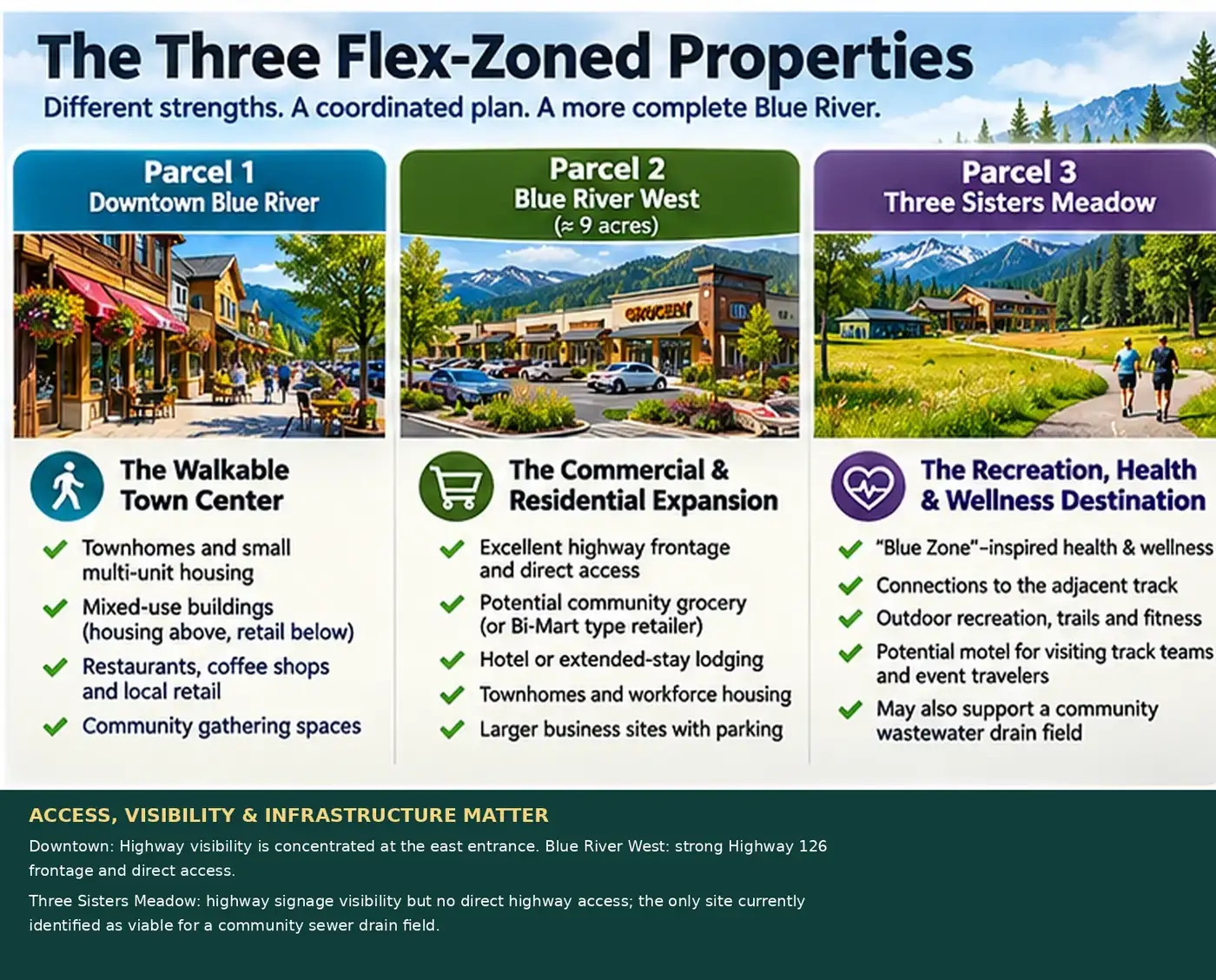
1. Downtown Blue River: the walkable town center
Downtown is not one large parcel. It is many smaller properties, most affected by the Holiday Farm Fire. The Blue River Complete Community Plan and its Flex zoning allow owners to rebuild as a more compact, walkable town center instead of simply replacing what stood before. Likely uses include:
- Townhomes, duplexes and small multi-unit buildings.
- Mixed-use buildings with shops below and homes above.
- Restaurants, coffee shops and small food businesses.
- Convenience and specialty retail, professional and community services.
- Public spaces and pedestrian connections.
Why it matters to the meadow: a lively downtown provides amenities the destination doesn’t have to build itself. Guests could walk into town for dinner or coffee, employees could find homes nearby, and downtown housing adds to the year-round population that keeps businesses open.
2. Blue River West: room for larger businesses
Blue River West is about 9 acres of Flex-zoned land with highway frontage, direct access and larger sites than downtown can offer, which suits businesses that need bigger buildings, parking and visibility. The property owner’s goals for Blue River West include:
- A community grocery store.
- A larger general-merchandise retailer, such as a Bi-Mart-type store, if the market supports it.
- A hotel or extended-stay lodging.
- Larger restaurants and recreation-oriented businesses.
- Townhomes and workforce housing.
A community grocery could serve residents, employees, visitors and lodging guests, and cut the drive downriver for everyday needs. A larger retailer would need a substantially bigger market and should be tested with a commercial feasibility study, not assumed. The property owner’s goal is to keep some larger sites intact for a possible anchor business later.
Disclosure: Blue River West is owned by Earth Quest Partners. MCP’s executive director, Chris LaVoie, is a principal of Earth Quest Partners.
3. Three Sisters Meadow: recreation, health and wellness
In late 2021, the Jones family, owners of the Seneca Family of Companies, donated the 16-acre former millsite to the Blue River community, and McKenzie River Trust agreed to hold it while a community planning process moves forward. No permanent owner has been chosen yet. It sits next to the Aaron and Marie Jones Community Track, which the family donated decades earlier.
There is strong interest in a Blue Zones-inspired destination that promotes healthy living, physical activity and community connection. Possible uses include:
- Walking trails, outdoor fitness and connections to the track.
- Health and wellness facilities and programs.
- A motel or lodge for recreation visitors and athletic teams.
- Townhomes, cottages and workforce housing.
- Community gathering and event space.
- Limited community wastewater infrastructure.
The lodging idea is worth a closer look in light of major events at Hayward Field in Eugene, when visiting teams and spectators need rooms outside the city. It deserves a real market study before anyone counts on it.
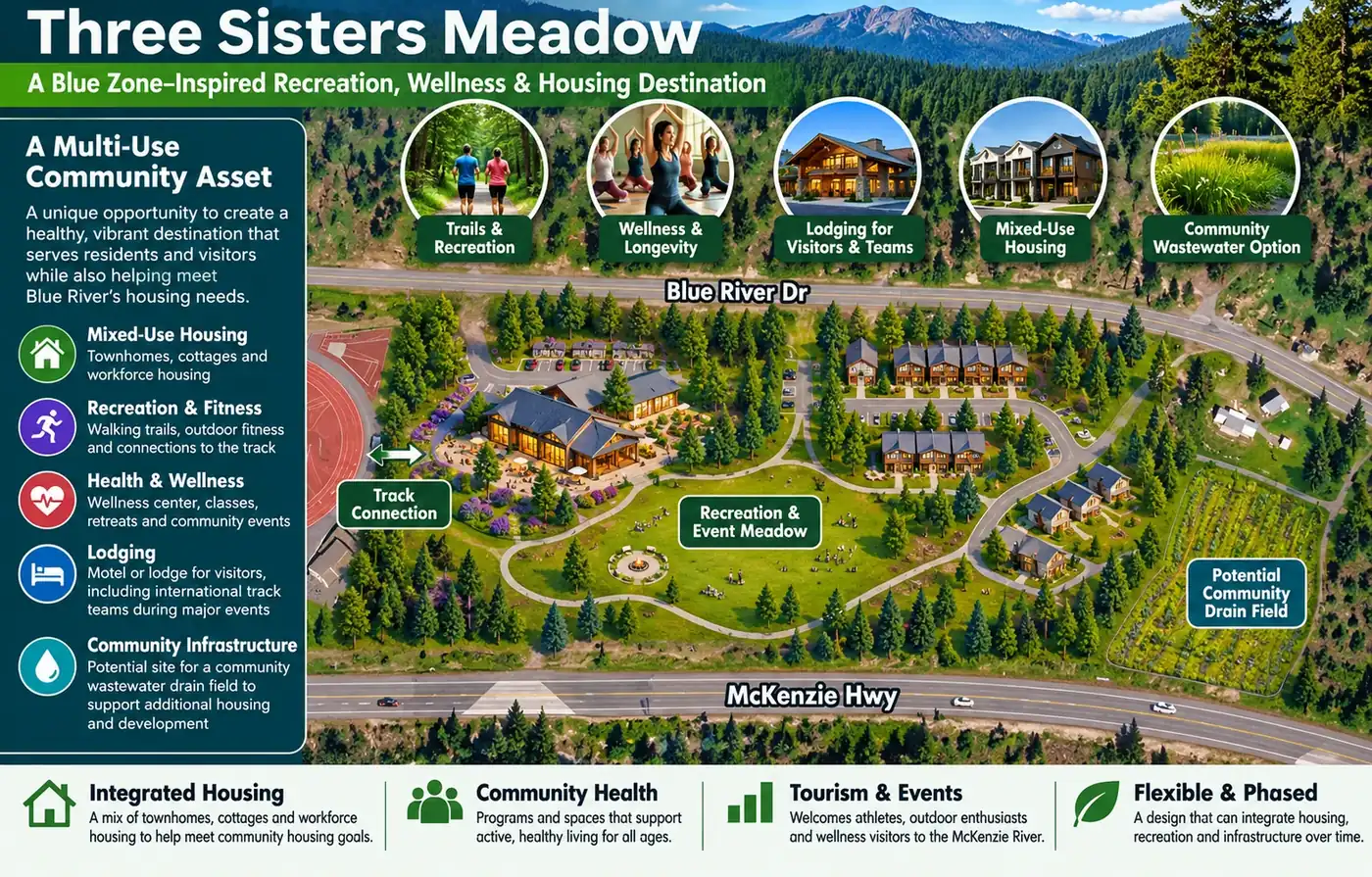
Housing and the numbers. Townhomes, cottages or mixed-use housing woven into the plan would add to Blue River’s housing goals and give workers a place to live. Our capacity estimate falls from about 165–470 homes to about 105–320 without housing at the meadow.
Why it matters to the rest of Blue River: visitors create demand for restaurants and shops, facilities create jobs, lodging brings overnight guests, and programs serve residents as well as tourists. A successful destination can give Blue River an identity that attracts new residents, businesses and investment. The relationship works both ways.
Why is housing the common thread?
Our earlier analysis set a preliminary goal of 400–600 more occupied, year-round homes in the Blue River commerce area. It is as much an economic development target as a housing one. More year-round residents mean:
- More customers for restaurants, a grocery, retail and recreation.
- A stronger workforce of employees who can afford to live here.
- Steadier local spending than seasonal visitors alone provide.
- More community life: activities, services, organizations and volunteers.
Each area can contribute. Downtown can hold townhomes and mixed-use buildings, Blue River West can add homes alongside larger businesses, and the meadow can weave housing into recreation and hospitality. Housing doesn’t compete with these other uses; it helps make them work.
Can shared wastewater solve Blue River’s growth limits?
Shared wastewater is an opportunity, not a complete solution. Soil conditions, groundwater and closeness to the McKenzie River make wastewater planning hard here, and Oregon’s Three Basin Rule adds limits to protect the river, a drinking-water source for more than 100,000 people.
What the published work shows so far:
| Stage | What was found | Source |
|---|---|---|
| HDR feasibility study (completed January 2024) | Drain fields at Blue River Park and Three Sisters Meadow, each about 2,500 gallons per day; estimated construction cost $3.5–4.3 million | McKenzie River Reflections, July 2024 |
| Groundwater analysis (submitted to DEQ November 2024) | DEQ concurred a 10,000 gpd facility may be permittable at the meadow, enough for up to about 33 homes or a mix of homes and businesses; possible expansion to 25,000 gpd if treatment standards are met | McKenzie Rebuilds |
| Earlier larger option | A 35,000 gpd system was ruled out because of unacceptable pollution levels | McKenzie Rebuilds |
| 35% engineering design | Expected to finish in spring 2025; we could not find the completed report or updated costs publicly | Lane County |
These figures come from different stages of study. None is final approved capacity, and none shows a larger system is affordable to build and run. A centralized system big enough for all of Blue River may not be economically or environmentally practical.
The rules have shifted a little. On December 2, 2025, Oregon’s Environmental Quality Commission amended the Three Basin Rule to let DEQ issue new water quality permits in the McKenzie basin under limited circumstances. That adds pathways worth exploring, but it doesn’t remove the duty to protect the river.
A combination of approaches
- Individual septic systems where soils and space allow, such as a fourplex on its own system on a 1/8-acre downtown lot.
- Shared cluster systems between neighboring properties, especially useful downtown where small lots struggle to fit a drainfield and its replacement area.
- Limited community capacity at the meadow, sized by engineering, regulatory and financial analysis, not by hope.
- Alternative treatment and dispersal, such as irrigation with well-treated wastewater. It wasn’t among the county’s drain-field alternatives and would need site engineering, groundwater and nutrient analysis, and DEQ approval.
Each area will need its own answer. Downtown may lean on cluster systems, Blue River West on individual or shared systems sized to its uses, and the meadow’s needs will depend on its mix of recreation, hospitality and housing. The meadow may provide limited community capacity, but the published capacity figures show it can’t carry the whole town.
The goal isn’t necessarily a sewer for all of Blue River. It’s practical, affordable and river-safe ways to allow more homes and businesses, without letting wastewater limits needlessly rule out good projects.
What changes when the three areas plan together?
| If each property develops on its own | If development is coordinated |
|---|---|
| Three Sisters Meadow must provide more services itself | Nearby businesses and services complement the destination |
| Employees struggle to find local housing | Housing grows across the community |
| Visitors have few nearby places to eat and shop | A wider mix of local businesses serves visitors |
| Larger commercial sites may be lost to early subdivision | Blue River West keeps sites for larger businesses |
| Wastewater is solved property by property | Individual, cluster and limited community systems are weighed together |
| Projects compete for the same uses | Each property focuses on its strongest advantages |
This isn’t about asking Three Sisters Meadow to fund or develop the other properties. Each owner pursues its own goals while supporting a shared vision for housing, infrastructure, connections and economic development. Nobody needs to own all three to benefit.
What could coordination look like?
It can start with practical cooperation among property owners, community organizations, developers and Lane County:
- Set shared housing and economic goals that build a population able to support local businesses and services.
- Coordinate wastewater planning across individual, cluster, limited community and alternative systems, without assuming one system serves everyone.
- Sort commercial uses: what belongs downtown, what needs Blue River West’s larger sites, and what complements the meadow.
- Plan walking and transportation links between downtown, Blue River West, the meadow, the track and the school.
- Attract complementary investment through joint business recruitment, developer outreach and funding applications.
- Protect future options by avoiding decisions that rule out housing, larger businesses or community amenities later.
These efforts can begin with conversations and a simple shared framework. A formal master plan can follow as partnerships develop.
A stronger Blue River benefits everyone
The Holiday Farm Fire created enormous challenges, but rebuilding also gives us a chance to build a stronger economic foundation than before. Three Sisters Meadow could become a regional destination, Blue River West could attract larger businesses and more homes, and downtown could become a walkable center with restaurants, shops, services and housing. Together they could add up to more than the sum of their projects.
The goal isn’t to make every property do everything. It’s to make sure each contributes to a larger community vision. Three Sisters Meadow doesn’t need to develop all of Blue River, but its long-term success is more likely if Blue River becomes a place where people can live, work, shop, eat, play and connect.
On the McKenzie River
- Wastewater project updates: McKenzie Rebuilds, Blue River Community Wastewater Project.
- Blue River Flex zoning: Rebuilding Blue River.
- MCP advises the Three Sisters Meadow group and can connect property owners with the agencies that decide. Contact us.
How can another town use this?
If your town is planning a destination project such as a sports complex, retreat center or trailhead hub, list the other development areas nearby and what each does best. Ask what the destination would otherwise have to build itself: housing for workers, food, lodging, wastewater. Every one of those that the town can provide instead lowers the project’s cost and risk.
Frequently asked questions
Does coordinating the three areas mean one developer or owner?
No. Each property keeps its own owners and plans. Coordination means agreeing on shared goals for housing, business mix, wastewater and connections, so the projects support each other instead of competing.
Can a wastewater system at Three Sisters Meadow serve all of Blue River?
No. DEQ has said a 10,000-gallon-per-day system at the meadow may be permittable, which could serve up to about 33 homes or a mix of homes and businesses. A 35,000-gallon system was ruled out. Blue River will need a combination of individual septic, shared cluster systems and limited community capacity.
Why include housing at a wellness and recreation destination?
Because the destination needs workers and nearby customers, and the town needs homes. Without housing at the meadow, our estimate of where Blue River’s new homes could go falls to about 105–320, well short of the 400–600 goal.
What changed with the Three Basin Rule?
On December 2, 2025, Oregon’s Environmental Quality Commission adopted amendments that let DEQ issue new water quality permits in the McKenzie and two other basins under limited circumstances. It opens a door to study, not a guarantee of approval.
The Blue River housing series
- How many homes does Blue River need to support a local economy?
- Where could Blue River’s new homes actually go?
- Why Three Sisters Meadow’s success is connected to Blue River’s future (this article)
Sources
- McKenzie Rebuilds: Blue River Community Wastewater Project
- McKenzie River Reflections: Blue River wastewater project updated (July 2024)
- McKenzie River Reflections: Could a pressurized sewer system help town’s comeback? (March 2024)
- HDR: Blue River Community Wastewater Feasibility Study
- Oregon DEQ: Three Basin Rule 2025 (adopted December 2, 2025)
- McKenzie River Reflections: Jones family makes another big gift (January 2022)
- Lane County: Blue River Complete Community Plan
General planning information, not engineering, market or legal advice. McKenzie Community Partnership doesn’t sell anything; we explain your options. Free to copy and adapt; please credit McKenzie Community Partnership.