

Short answer
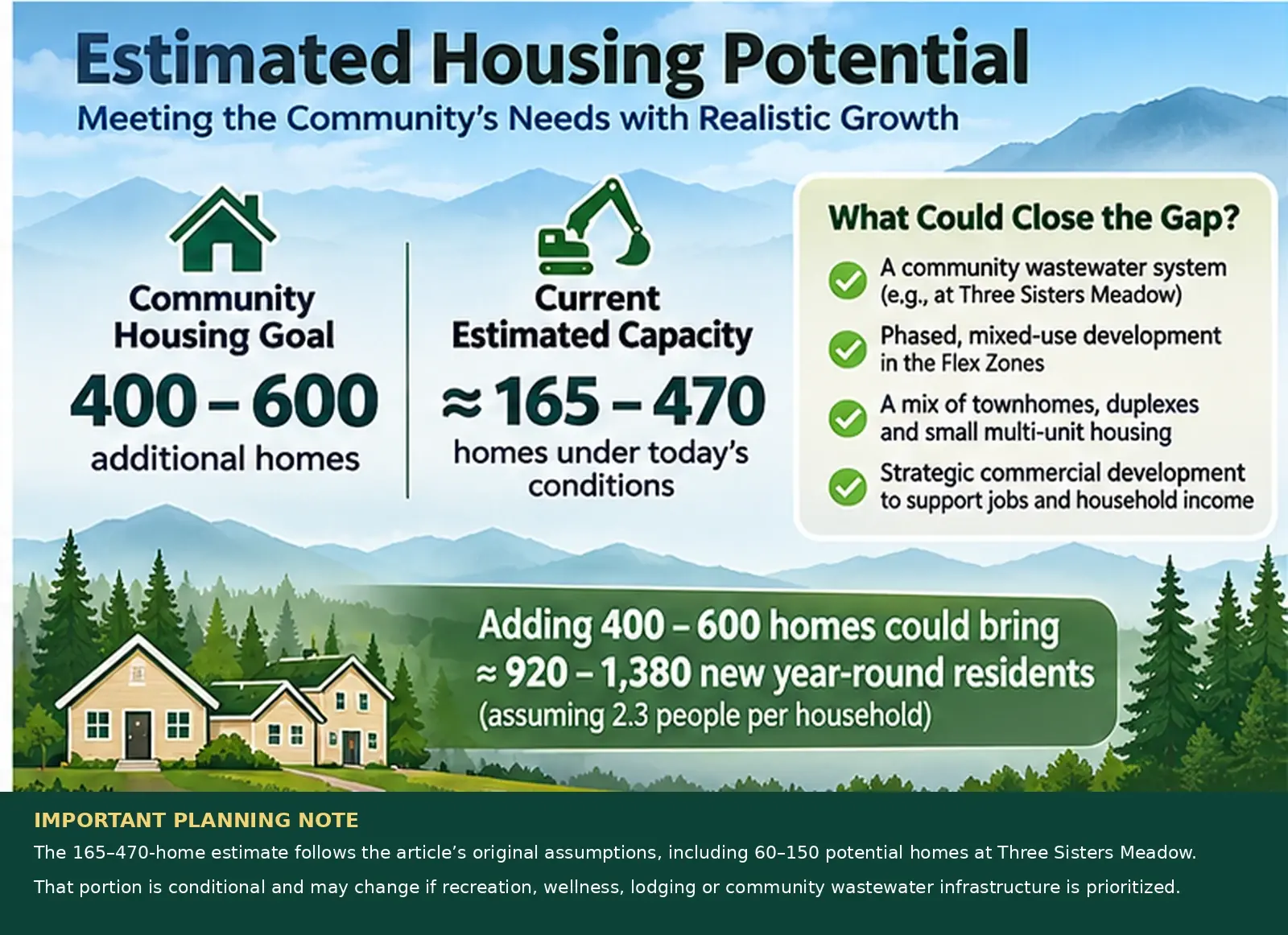
Reaching 400 new year-round homes in the Blue River commerce area is possible but tight, and 600 likely needs a community-scale wastewater solution. Most land from Finn Rock to McKenzie Bridge is in rural lots of 2 acres or more, which can add one accessory dwelling each but not much else. That puts the weight on the Blue River Flex zone: the downtown lots, Three Sisters Meadow and Blue River West, the Earth Quest Partners land where McKenzie River Mountain Resort stood. On our planning assumptions, those Flex areas hold most of the realistic room: about 150–410 of the roughly 165–470 homes we can find space for today.
Last reviewed November 18, 2026 by McKenzie Community Partnership. Applies to the Blue River commerce area, Finn Rock up through McKenzie Bridge. Part 2 of the Blue River housing series; part 1 is How many homes does Blue River need?
Executive summary
Blue River needs 400–600 more year-round homes to support a real local economy. On today’s rules and septic, we can find room for about 165–470. The gap is closable, but only with deliberate choices.
- Rural lots won’t carry the load. Most of the corridor is in 2-acre-plus rural lots. Lane County now allows one ADU on many of them, and every one must be a long-term home, but realistic uptake adds tens of homes, not hundreds.
- The Flex zone is where the homes are. Downtown lots, Three Sisters Meadow and Blue River West could hold about 150–410 homes, most of what’s possible.
- Downtown has already started. The general store’s apartments, a fourplex on Rose Street and land trust apartments over shops show the model works.
- Two large sites are the swing vote. Three Sisters Meadow and Blue River West could add 90–240 homes. Without housing at the meadow, the total falls to about 105–320, well short of 400.
- Wastewater sets the ceiling. At about $25,000 per home, septic caps a 1/8-acre lot at roughly four homes. Reaching 600 takes a shared wastewater solution.
What the numbers leave open: how many eligible rural parcels and vacant lots exist, how many downtown owners will build housing, whether the two large Flex sites include housing, and how much shared wastewater capacity is achievable. The rest of this article shows the numbers behind each point.
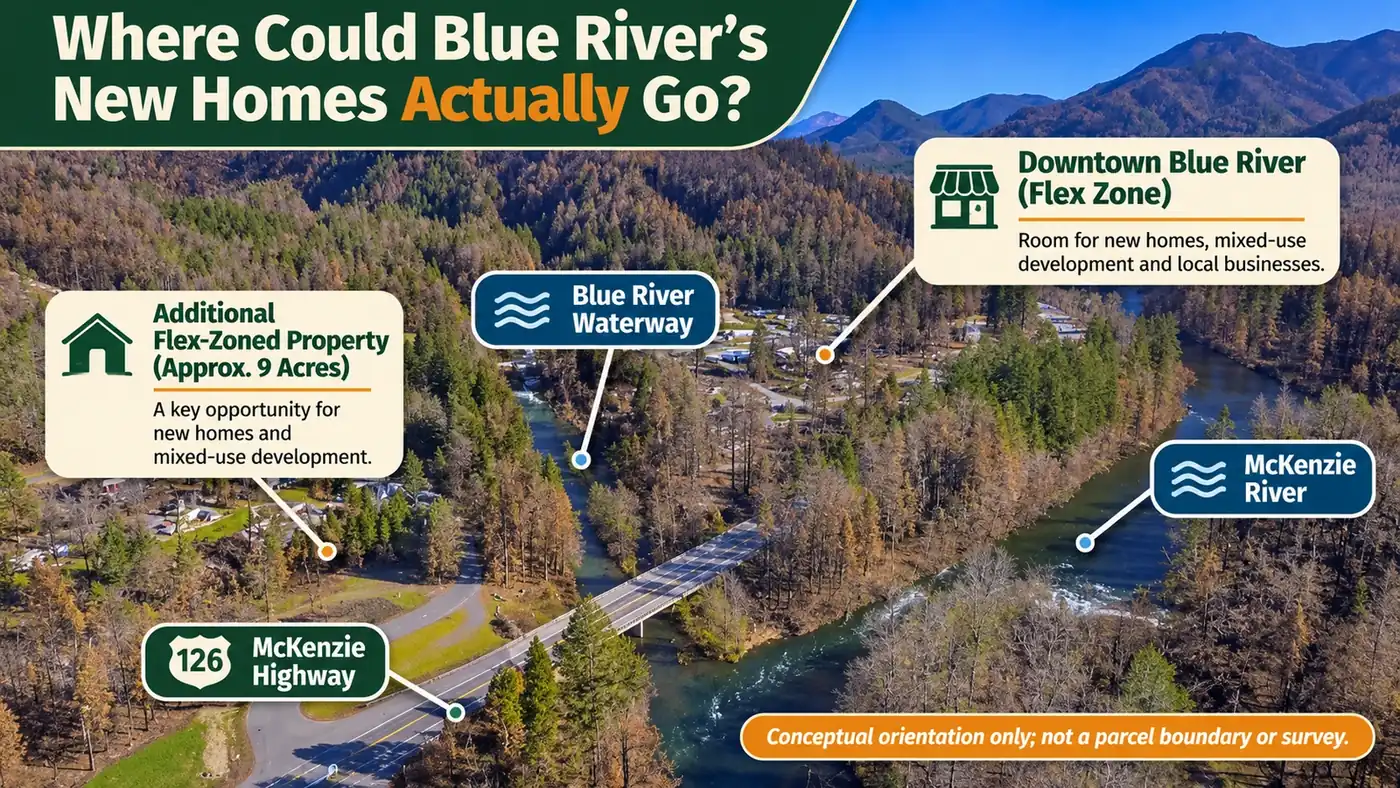
Where could 400–600 homes fit?
On today’s rules and septic-based building, we can find room for roughly 165–470 new year-round homes. That reaches the low end of the target only if nearly everything goes right.
| Source | Homes possible (planning range) | Main limit |
|---|---|---|
| Already underway downtown | About 8–10 | General store apartments, Rose Street fourplex, land trust apartments |
| Rural ADUs on 2+ acre lots | 15–60 | One per lot; owner has to want one and afford it |
| Vacant buildable rural lots | Not yet counted | Many empty lots can’t pass septic or setback rules |
| Remaining downtown Flex lots (perhaps 50–55) | 50–160 | Septic sizing, cost and owner plans |
| Three Sisters Meadow (16 acres, Flex) | 60–150 | Only if housing stays in the plan alongside recreation, lodging and a possible community drain field |
| Blue River West: Earth Quest Partners land, former McKenzie River Mountain Resort (about 9 acres, Flex) | 30–90 | Owner’s plans; septic |
| Total | About 165–470, plus any vacant rural lots |
How we got these ranges:
- ADUs: an estimated 150–300 eligible rural parcels with a home, with 10–20% adding an ADU over about 10 years.
- Downtown: about 64 lots, of which perhaps 50–55 are still open after public buildings, rebuilt homes and projects underway. The low end assumes about half get housing at two homes each; the high end assumes three-quarters become fourplexes.
- Larger sites: about 70% of the land left after roads and open space, divided into 1/8-acre lots. The low end is one home per lot; the high end mixes in duplexes and fourplexes.
If a shared wastewater system replaces lot-by-lot septic, these numbers could rise a lot, because buildings would no longer need room for their own drainfields.
How much can rural ADUs add?
Rural accessory dwelling units help, but they add homes slowly, one lot at a time. On August 29, 2023, Lane County adopted Ordinance 23-05, which allows one ADU on Rural Residential land under Oregon’s SB 391. The main rules:
- The lot must be zoned Rural Residential and be at least 2 acres. Forest and farm zones don’t qualify.
- There must already be a single-family home on the lot.
- The ADU can be up to 900 square feet and must sit within 100 feet of the existing home.
- It can’t be used as a vacation rental, and it can’t be split off and sold separately.
- The property must be served by a fire protection provider.
In 2025 the Legislature repealed the statewide wildfire hazard map and removed the map-based conditions on rural ADUs. Fire-resistant construction and access rules still apply.
The no-vacation-rental rule matters here: every rural ADU is, by law, a long-term home, which is exactly what the target needs. The limits are cost and owner interest. Each ADU still needs septic capacity, about $25,000 per home on a new system, plus construction. So even generous uptake adds tens of homes over a decade, not hundreds.
What we still need: the number of Rural Residential parcels of 2+ acres with a home, Finn Rock to McKenzie Bridge. Many parcels in the corridor are zoned for forest use, so the eligible number may be well below the total count of rural homes.
Why is the downtown Flex zone so important?
Downtown Blue River is the one place in the corridor zoned for town-scale housing. In October 2024, Lane County approved the Blue River Complete Community Plan and its Flex zoning, which allows homes, shops and mixed-use buildings along a walkable Blue River Drive.
There are about 64 lots downtown, in many sizes and owned by many different people. Some are already spoken for: a few have rebuilt single-family homes, and others hold the library, the fire station and the medical clinic. On a 1/8-acre lot with its own septic system, a fourplex is about the practical limit. Septic runs roughly $25,000 per home, so a fourplex carries about $100,000 in wastewater cost before the building starts.
Downtown housing has already started. Projects built or underway include:
- The general store, almost rebuilt, with 2 apartments.
- A fourplex on Rose Street.
- Shops with a few apartments above at McKenzie Street and Blue River Drive, a McKenzie Community Land Trust project.
What that means for capacity:
- If every lot held a fourplex: about 200–220 homes on the lots still open. That won’t happen, because some lots will be shops, offices, lodging or parking.
- More realistic: 50–160 more homes, depending on how many owners build housing and how many choose fourplexes over single homes.
- The swing factor is wastewater. MCP helped secure $15.5 million in state funding for Blue River water and sewer, but the community sewer is designed, not built. A shared system would free each lot from its drainfield and could allow apartments above shops.
Because the lots are held by many owners, downtown housing will come one decision at a time unless owners plan together. A later article in this series will look at how they can.
How much depends on Three Sisters Meadow and Blue River West?
A lot. Together these two sites could supply 90–240 homes, more than downtown on the high end, and likely the difference between missing the target and reaching 400. They matter for three reasons:
- They are large and have few owners. One decision can plan dozens of homes with streets, open space and a mix of prices, instead of waiting on many separate owners.
- They can be laid out from scratch. A site plan can place lots so septic drainfields fit, and leave room for a shared system later.
- They sit next to downtown. New residents would be within walking distance of the businesses the first article showed the town needs.
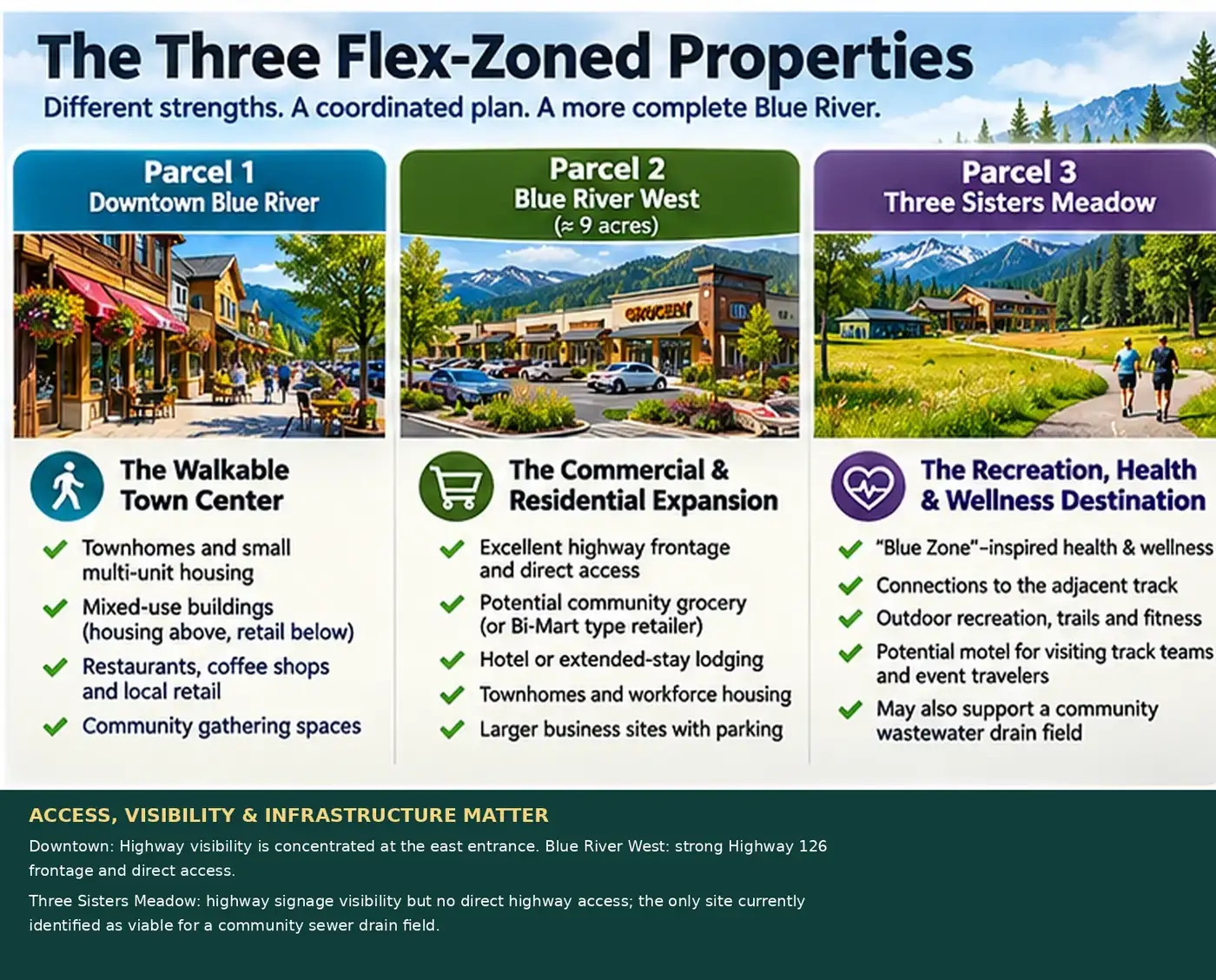
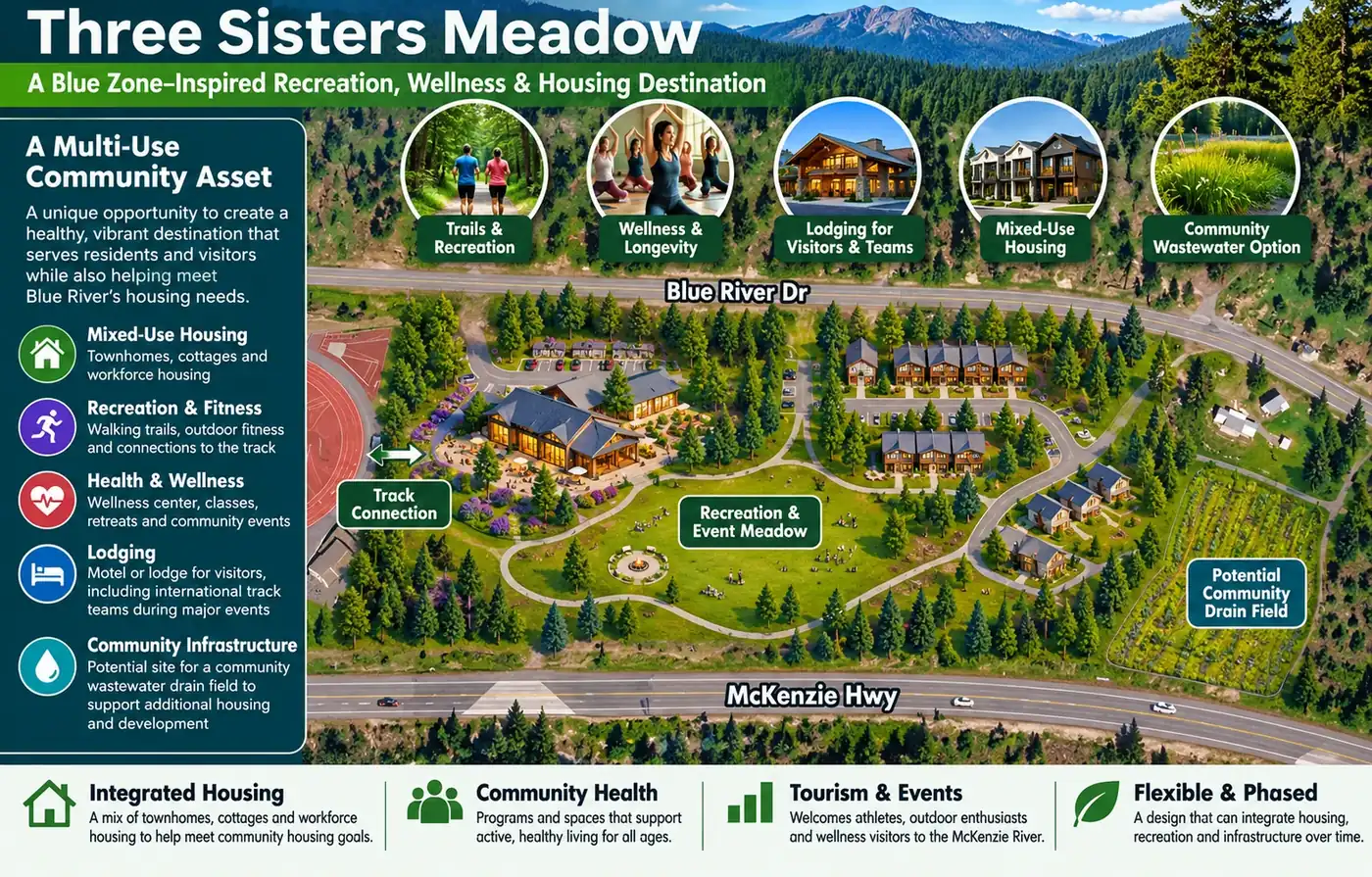
Three Sisters Meadow is a 16-acre former millsite, zoned Blue River Flex, donated to the Blue River community in 2021. McKenzie River Trust holds it while a group of local nonprofits plans its future; no permanent owner has been chosen yet. Ideas include a recreation, health and wellness destination with trails and fitness, connections to the adjacent track, and possibly a motel for visiting teams and event travelers. It is also the only site identified so far as viable for a community sewer drain field, which could unlock more homes across all three Flex areas.
What if the meadow has no housing? Without homes at the meadow, the capacity estimate falls to about 105–320, well short of 400. The effect wouldn’t stay at the meadow. Downtown shops, Blue River West businesses and the meadow’s own wellness and lodging uses all need nearby customers, and workers who can afford to live here. Even part of the site in housing keeps the target within reach, whether as 1/8-acre lots on individual septic, which can stay under Lane County’s approval threshold, or as homes served by a future drain field. The Three Basin Rule, which limits nitrates entering the McKenzie, needs checking early either way.
Blue River West, the Earth Quest Partners land, is about 9 acres of Blue River Flex land west of downtown, with strong Highway 126 frontage and direct access. It includes the former McKenzie River Mountain Resort site. The property owner’s goals include a community grocery or similar retailer, hotel or extended-stay lodging, townhomes and workforce housing, and larger business sites with parking. Disclosure: MCP’s executive director, Chris LaVoie, is a principal of Earth Quest Partners.
Neither site is a sure thing. Both depend on owners who have their own plans, and on wastewater that works at a larger scale. Both plans are still open.
What does this mean for Blue River?
The land math points to five factors that will decide whether the target is reachable:
- Parcel counts. County numbers for eligible rural parcels and vacant buildable lots would replace the estimates above.
- Rural ADUs. They’re legal now, long-term by law and need no new infrastructure, but they add homes slowly.
- Downtown. Fourplexes on Flex lots are the fastest route to town-scale housing; timing depends on many separate owners.
- The two large Flex sites. Whether Three Sisters Meadow and Blue River West include housing largely decides whether the total reaches 400.
- Shared wastewater. In these numbers, it is the only path from about 400 homes to 600.
On the McKenzie River
- Rural ADU applications go through Lane County Land Management.
- Blue River Flex zoning details are on our Rebuilding Blue River page.
- MCP advises the Three Sisters Meadow group and can connect property owners with the agencies that decide. Contact us.
How can another town use this?
List every place homes could go (backyards, downtown lots, larger sites), give each a low and high count based on real limits like septic and lot size, and compare the total with your target. The gap shows where to focus.
Frequently asked questions
Can I build an ADU on my rural property?
If your lot is zoned Rural Residential, is at least 2 acres and already has a home, likely yes. Forest and farm zones don’t qualify, and the ADU can’t be a vacation rental.
Why can’t downtown lots hold more than four homes?
On septic, each home needs drainfield space, and about four homes is what a 1/8-acre lot can reasonably serve at around $25,000 per home. A shared sewer system would change that.
Does this mean the 400–600 target is unrealistic?
No, but it means the low end depends on nearly every site doing its part, and the high end depends on a shared wastewater solution.
Why not just build on the empty rural lots?
Many empty lots in the corridor can’t pass septic, slope or setback rules. Until we have a count of truly buildable vacant lots, we’ve left them out of the total.
Why include housing at Three Sisters Meadow if it becomes a wellness destination?
Without homes at the meadow, the area’s capacity falls to about 105–320, short of the 400-home goal. Every business and lodging use in the three Flex areas also depends on nearby customers and workers.
The Blue River housing series
- How many homes does Blue River need to support a local economy?
- Where could Blue River’s new homes actually go? (this article)
- Why Three Sisters Meadow’s success is connected to Blue River’s future
Sources
- Lane County: Accessory Dwelling Units (Ordinance 23-05, SB 391)
- Lane County Ordinance 23-05
- Oregon Legislature: 2025 measure removing wildfire map conditions on rural ADUs
- Lane County: Blue River Complete Community Plan
- McKenzie River Mountain Resort: Future plans
General planning information, not a land survey, market study or legal advice. McKenzie Community Partnership doesn’t sell anything; we explain your options. Free to copy and adapt; please credit McKenzie Community Partnership.