

Short answer
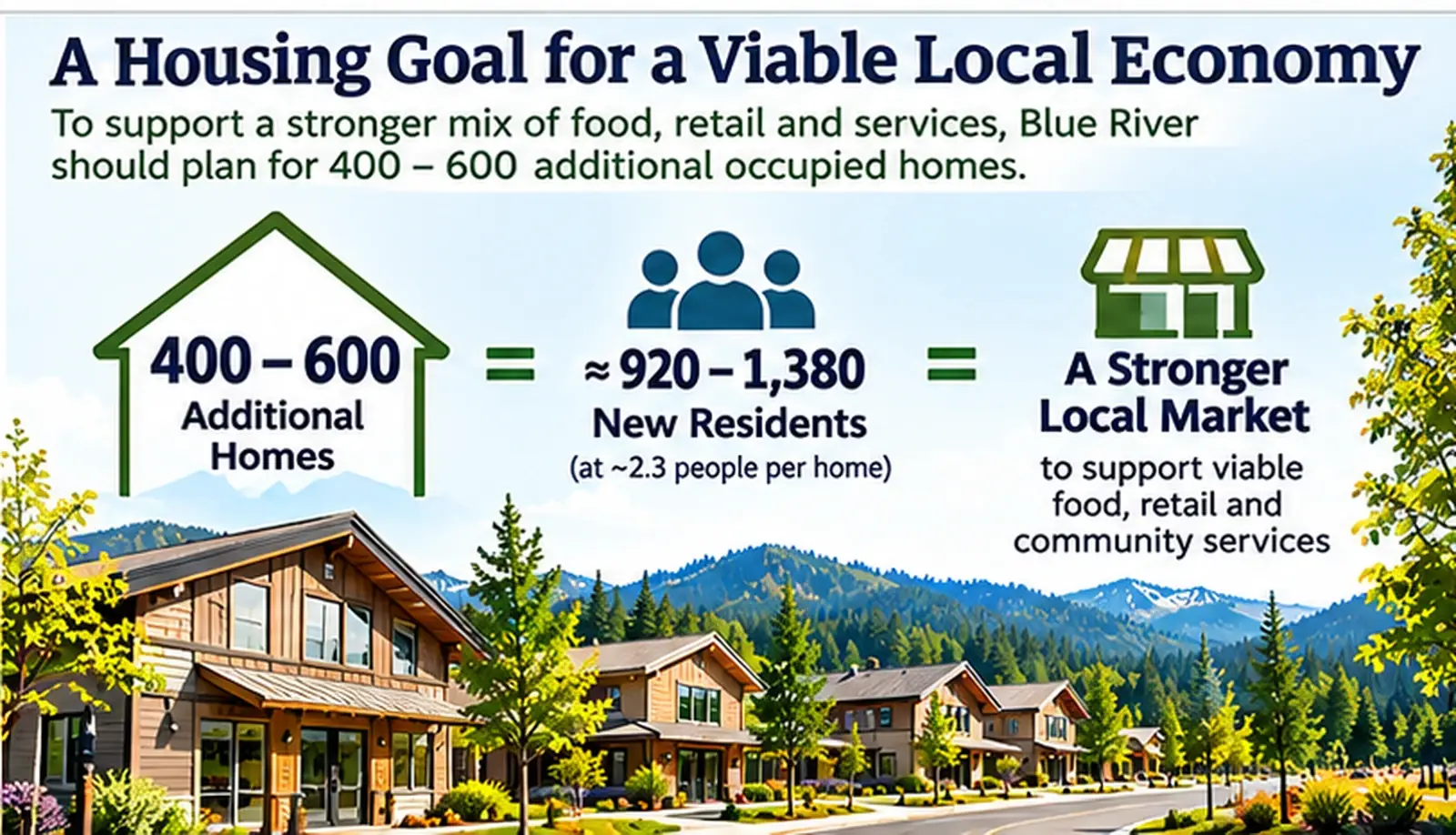
There is no magic number, but small-town businesses need a steady base of year-round customers who spend locally. Population ranges for small rural towns point to roughly 400–600 more occupied, year-round homes across the Blue River commerce area, from Finn Rock up through McKenzie Bridge. At about 2.3 people per household, that is 920 to 1,380 more residents. That scale could make a café, more food options, specialty retail and small recreation businesses realistic. It is a planning illustration, not a market study, and it depends on household income, local jobs, wastewater capacity and attainable housing.
Last reviewed November 18, 2026 by McKenzie Community Partnership. Applies to Blue River and the upper McKenzie River communities, with lessons for any small rural town rebuilding after a disaster. A McKenzie River companion to the Small-Town Economics series.
Why does rebuilding take more than replacing homes?
Since the Holiday Farm Fire in 2020, the McKenzie River communities have been rebuilding homes, businesses and the infrastructure behind everyday life. Real progress has been made. But a community is more than its count of rebuilt structures.
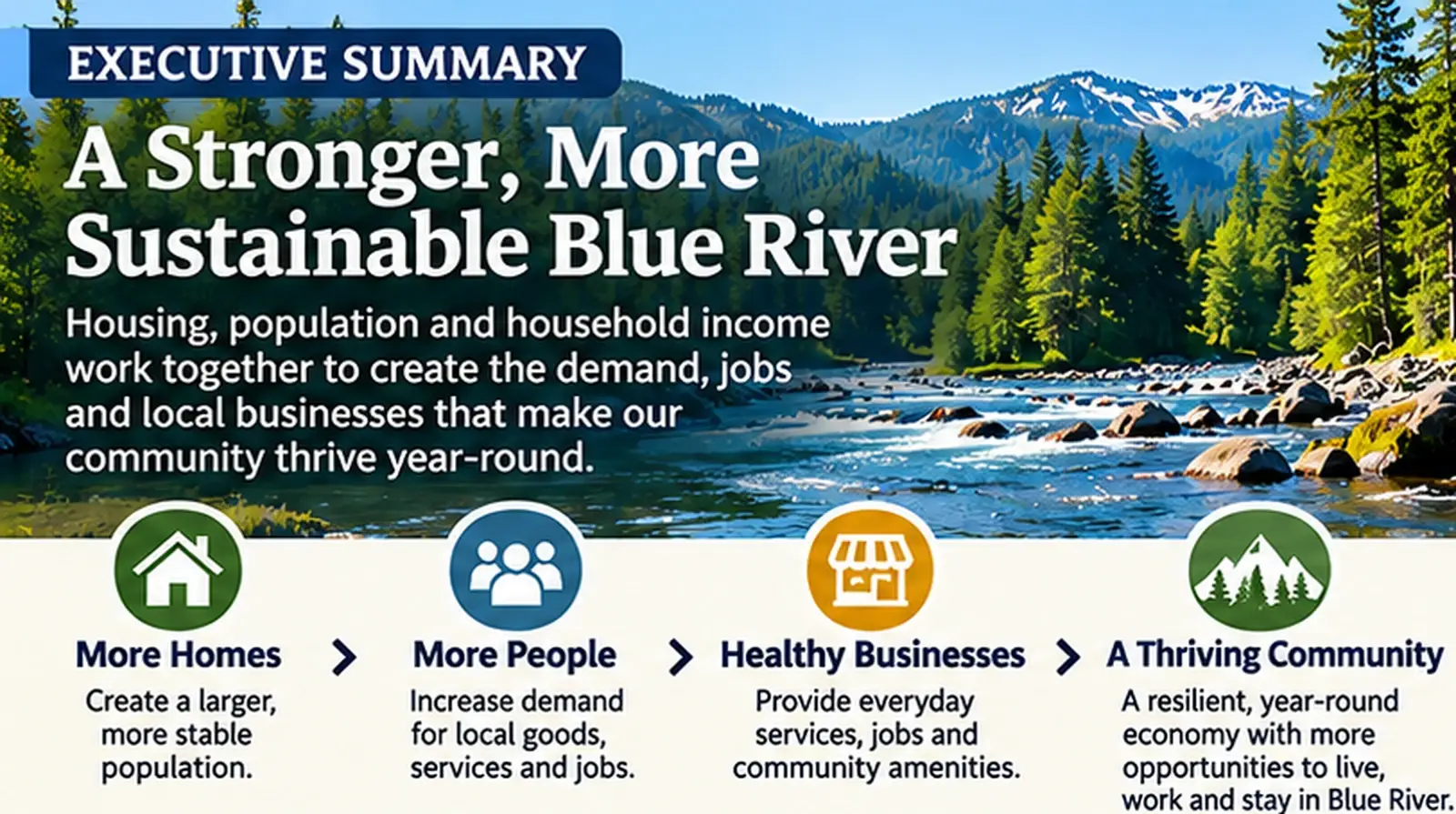
A healthy town needs enough year-round residents to support local businesses, enough household income to keep those businesses open, and enough economic opportunity to attract and keep the people who make it home. These pieces depend on each other:
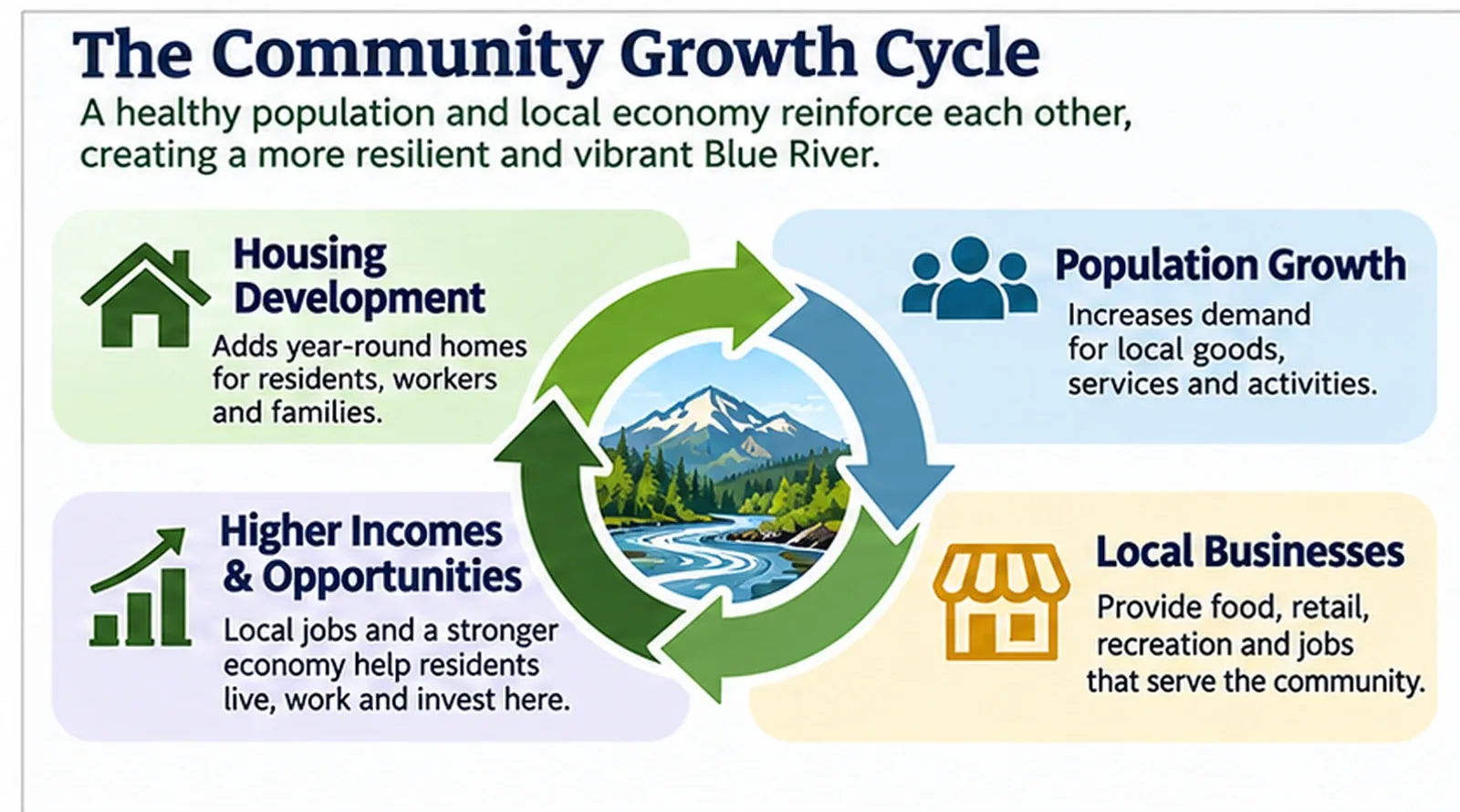
- Housing makes population growth possible.
- Population creates demand for goods and services.
- Household income decides how much of that demand becomes local spending.
- Local businesses provide the jobs, services and amenities that make a town worth moving to.
If we plan for only one of these, we risk rebuilding individual properties without rebuilding the economic foundation of the community.
Why is population the foundation of a local economy?
Small rural towns have fewer potential customers, smaller labor pools and higher costs for delivering most goods and services. A restaurant, coffee shop, grocery or fitness studio needs enough customers, close enough, visiting often enough and spending enough, to cover its costs.
In a small community, the difference between 300 households and 800 households is substantial. A café needs customers in February, not just on summer weekends. A shop needs steady local spending to carry inventory, pay staff and cover rent. A fitness studio needs members, not occasional visitors.
Tourism adds valuable revenue, but it rises and falls with seasons, weather, fuel prices and travel habits. On the McKenzie, it can also disappear for a season when fire or smoke closes the corridor. Everyday businesses should not depend on visitors alone. Building a stronger year-round population is one of the most important investments we can make in long-term recovery.
For the general numbers behind this, see How many people does it take to support a grocery store or restaurant?
Why isn’t population enough on its own?
The number of residents is only half the equation. A town with plenty of people but little spare income can still struggle to keep businesses open. A smaller town with stronger household incomes can generate more local spending.
For context, the median household income in Lane County was $69,311 (2019–2023, U.S. Census Bureau). Incomes in the upper McKenzie vary widely, from retirees on fixed incomes to tradespeople, business owners and remote workers.
The goal is not simply to attract higher-income residents. It is an economy where people at many income levels can earn, spend and build their lives locally, and where housing stays within reach of the people who work here. Working families, tradespeople, service workers, professionals, entrepreneurs and retirees all add to the town’s economic and social fabric.
That means encouraging a mix of work:
- Small businesses that serve everyday needs
- Hospitality, lodging and outdoor recreation businesses that bring in visitors
- Skilled trades, construction and professional services
- Remote work and home-based businesses
- Community organizations and public services
- Room for entrepreneurs to start and grow
More on this in What income and spending does a small town need? and Where do jobs come from in a small rural town?
How many homes support which kinds of businesses?
There is no universal answer. A food cart runs on a very different budget than a full-service restaurant, and a small fitness studio needs far fewer customers than a large gym. Population is still a useful starting point.
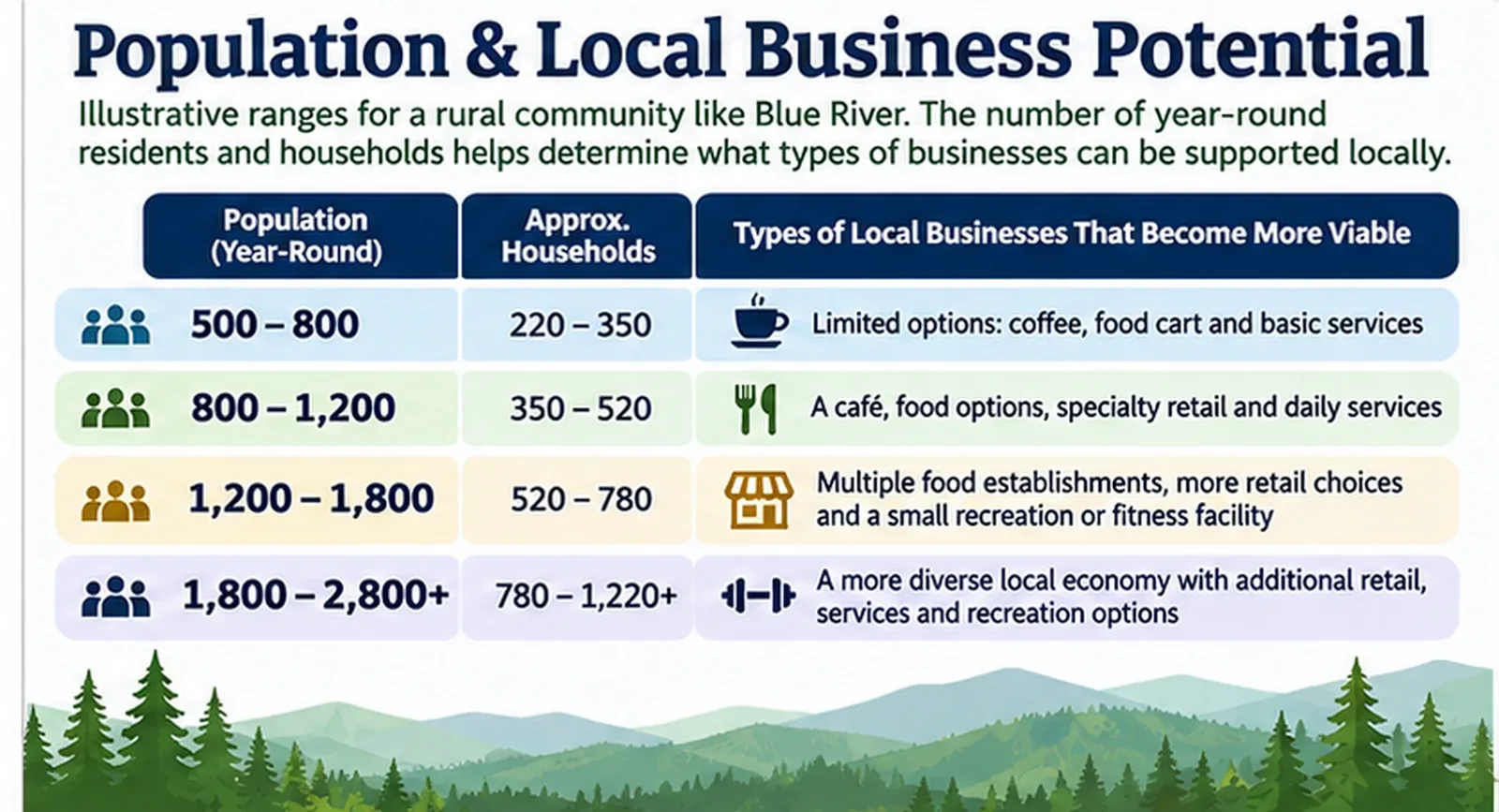
These illustrative ranges assume about 2.3 residents per occupied household and mostly year-round customers.
| Year-round population | About how many households | What becomes more plausible |
|---|---|---|
| 500–800 | 220–350 | Limited food options, small convenience retail, community services |
| 800–1,200 | 350–520 | A small café, food carts, specialty retail, basic services |
| 1,200–1,800 | 520–780 | Several food businesses, more retail choice, small recreation facilities |
| 1,800–2,800 | 780–1,220 | A more varied business district with added services and recreation |
| 2,800+ | 1,220+ | A broader range of everyday businesses and services |
These are planning illustrations, not guarantees. Real viability depends on household income, competition, operating costs, spending habits and how much spending local businesses capture.
Why does local spending matter so much?
Upriver residents often drive to Eugene and Springfield for groceries, supplies and services. That makes sense when local choices are limited, but it feeds a cycle:
- Residents spend most of their money elsewhere.
- Local businesses have fewer customers, and some close.
- With fewer local choices, residents have even less reason to shop locally.
Breaking the cycle takes both more year-round residents and a better mix of local businesses. We should not assume crowds will drive upriver because a new business opens. Economic development should first serve local residents and capture a fair share of the spending that already happens here. Tourism, recreation and Highway 126 traffic should add to that base, not replace it.
Why is housing development also economic development?
Housing and business development are often treated as separate issues. They are closely tied. Every added year-round household brings potential customers, volunteers, employees and contributions to the local tax base.
Housing also eases the worker shortage that holds businesses back. Businesses can’t grow without people to staff them, and workers can’t live locally without places to live. That makes housing a core economic development strategy.
Blue River has a particular opportunity here. Its Flex-zoned downtown lots allow a wider variety of housing, including apartments, townhomes, workforce housing and mixed-use buildings with shops below and homes above. Instead of judging each project alone, we should ask how much residential growth the whole community needs to support a working local economy. See Workforce housing vs. low-income housing: what’s the difference?
What growth target makes sense for Blue River?
Comparing today’s population with the ranges above points to 400–600 more occupied, year-round homes as the scale that could give the local economy across the Blue River commerce area a meaningful foundation. This is a planning estimate drawn from those ranges, not a market study. The commerce area runs from Finn Rock up through McKenzie Bridge: the people who live close enough to shop, eat and use services in Blue River regularly. At about 2.3 people per household, that is 920 to 1,380 more residents.
For scale, ZIP code 97413 (Blue River and McKenzie Bridge) had about 445 households averaging 2.27 people each. The Census Bureau estimated 818 residents in 2024, down from 1,012 in the April 2020 Census, taken months before the fire. Adding 400–600 homes would roughly double the number of households and bring the area to about 1,700–2,200 year-round residents. That is the range where a café, several food options, specialty retail and small recreation facilities become realistic.
To be honest about the limits of this number:
- It is not a market study. It is a starting point for understanding the scale of growth that would make a difference.
- Only year-round homes count. Vacation rentals and second homes bring visitor spending, but not year-round customers, workers or volunteers.
- Wastewater sets the ceiling. On a 1/8-acre downtown Blue River lot, a fourplex can work on its own septic system, so the Flex lots can add real housing now. Reaching 400–600 homes across the commerce area will take more: the community will need to find an efficient wastewater solution that can grow with the town.
- The mix matters as much as the count. 500 homes that only high earners can afford would not give local businesses the workers they need.
What does a healthy, sustainable community look like?
A sustainable community isn’t one with a big commercial strip. It is one where residents can meet more of their everyday needs locally, businesses have enough customers to stay open, and people can earn a reasonable living. It aims for:
- A balanced population: housing types and prices for working families, singles, seniors and people at every stage of life.
- Incomes that support local commerce: jobs and conditions that let residents take part in the local economy.
- A diverse business base: food, retail, recreation and services that give people reasons to spend locally.
- A strong local workforce: housing and jobs that let businesses hire and keep employees.
- Tourism as a complement: visitors who add spending without becoming the only foundation.
- Places to gather: parks, recreation, restaurants, public spaces and events that make the area a good place to live.
Each piece strengthens the others. More residents support more businesses. More businesses provide services and jobs. More jobs help households earn more. Together they make the community more resilient.
What should we be asking as we rebuild?
The Holiday Farm Fire created an enormous challenge. It also gave us a chance to think differently about the future. Replacing what was lost matters, but we don’t have to stop at restoring the community exactly as it was. We can build a stronger economic foundation, more housing choices and room for more kinds of businesses.
That takes cooperation among property owners, developers, business owners, local governments, community organizations and residents. It also means weighing each project not only by what it does for one property, but by what it adds to the long-term health of the whole community.
The question isn’t simply how many homes we can rebuild or how many businesses we can recruit. It is this: what combination of housing, population, household income and economic opportunity will let the McKenzie River communities become healthy, vibrant and economically sustainable places to live? That is the goal worth planning for.
Read next: Where could Blue River’s new homes actually go? tests this target against the land that can actually take homes. Then see why Three Sisters Meadow’s success is connected to Blue River’s future.
On the McKenzie River
- Blue River had about 200 residents in 2025, down from about 280 before the 2020 Holiday Farm Fire. ZIP code 97413 (Blue River and McKenzie Bridge) counted 1,012 residents in the 2020 Census and an estimated 818 in 2024, in about 445 households.
- This article treats the commerce area as Finn Rock up through McKenzie Bridge: the people close enough to shop and eat in Blue River regularly.
- Downtown Blue River has about 64 buildable Flex-zoned lots held by many different owners. Flex zoning allows housing, shops and mixed-use buildings.
- Follow the work on the Community Building hub and the Rebuilding Blue River project page.
- McKenzie Community Land Trust works on permanently affordable homes in the corridor.
- Lane County Land Management Division handles zoning, land use and building permits for the unincorporated McKenzie communities.
- Want to help shape the rebuild? Contact McKenzie Community Partnership.
How can another small town use this approach?
Any rural town rebuilding after a fire, flood or mill closure can work through the same questions:
- Count year-round households, not houses. Start from Census or American Community Survey data, then subtract seasonal homes and vacation rentals.
- Find out where residents spend now. A short survey asking where people buy groceries, fuel, meals and services shows how much spending leaves town.
- Use population ranges as a rough guide. Adjust up or down for local incomes, competition and how far the next larger town is.
- Check infrastructure limits first. Wastewater, water and road access often decide how many homes are possible before the market does.
- Plan the housing mix, not just the count. Include homes that local workers can afford, alongside market-rate and senior housing.
- Treat visitors as a bonus. Size businesses to year-round demand and let tourism lift the good months.
Frequently asked questions
Does this mean Blue River would become a big town?
No. Even at the top of the range, the added homes would bring about 1,400 residents spread from Finn Rock to McKenzie Bridge. That is still a small rural town, just one large enough to keep a café and a few shops open year-round.
Do vacation rentals count toward the 400–600 homes?
No. The target counts only homes occupied year-round. Short-term rentals bring visitor spending, but they don’t add steady winter customers, workers or volunteers.
Is this about low-income housing or workforce housing?
Both have a role, and they are different. Workforce housing is priced for working households such as teachers, tradespeople and service workers who earn too much for subsidized programs but can’t afford market prices. A healthy mix includes market-rate, workforce and income-qualified homes.
Can Blue River’s infrastructure support this many homes?
Not yet at full scale. A fourplex on its own septic system works on a 1/8-acre downtown lot, which gives the Flex zone a starting point. Reaching the full target will take an efficient, community-scale wastewater solution, and finding one is a job for the whole community.
Where does 2.3 people per household come from?
It is a rounded planning figure. The Census Bureau puts ZIP code 97413 at 2.27 people per household and Lane County at 2.33 (2020–2024).
The Small-Town Economics series
- How many people does it take to support a grocery store or restaurant?
- What income and spending does a small town need?
- Where do jobs come from in a small rural town?
- Workforce housing vs. low-income housing: what’s the difference?
- What brings remote workers to a rural town?
Sources
- U.S. Census Bureau QuickFacts: Lane County, Oregon (median household income; 2.33 persons per household, 2020–2024)
- USAFacts: household income in Lane County, Oregon
- U.S. Census Bureau: ZIP code 97413 households, household size and population (2020 Census, 2024 ACS)
This article is general planning information, not a market study or financial, legal or planning advice. McKenzie Community Partnership doesn’t sell anything; we explain your options. Free to copy and adapt; please credit McKenzie Community Partnership.