

Short answer
Between 5 and 30 feet from your house, the goal is to keep fire low and slow so it can’t climb into trees or race to the walls. Limb trees up 6 to 10 feet, keep at least 10 feet between tree crowns, remove shrubs under trees, mow grass to 4 inches, and move woodpiles and propane well away from the house.
Last reviewed October 31, 2026 by McKenzie Community Partnership. Step 5 of the Fire-Ready Homes checklist. Applies to homes across the Cascades and the rural West.
Why this zone matters
A fire that stays on the ground is slow and easier to fight. When it finds a “ladder” of shrubs and low branches, it climbs into the tree crowns, throws more embers and burns hotter against the house. Breaking up that ladder is the job of this zone. Oregon State University Extension calls it “Lean, Clean, and Green.”
Rock or bare soil against the walls. No mulch, plants, woodpiles or wood fence.
The first 5 feet →Limb trees up 6–10 ft, 10 ft between crowns, no shrubs under trees, grass under 4 in.
5 to 30 feet →Thin crowded trees, remove dead ones and ladder fuels, chip or haul slash. Up to 200 ft on slopes.
30 to 100 feet →The checklist
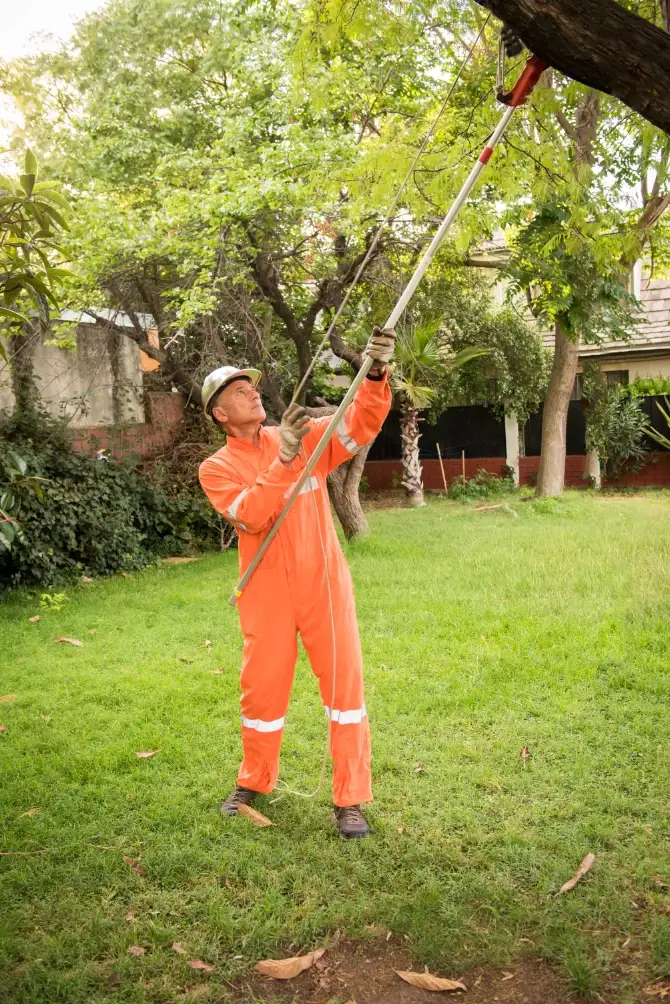
- Limb up trees 6 to 10 feet from the ground. On small trees, remove no more than one-third of the height.
- Space tree crowns at least 10 feet apart, more on slopes. Thin dense clumps, keeping the healthiest trees.
- Remove ladder fuels: shrubs and small trees growing under larger ones.
- Keep shrubs in small, separated groups, not continuous hedges.
- Keep branches 10 feet from the roof, eaves, walls and chimney.
- Mow grass to 4 inches or less and rake the clippings.
- Remove dead plants, fallen branches, needles and leaves.
- Move firewood and lumber at least 30 feet from the house.
- Clear 10 feet around propane tanks.
- Treat outbuildings within 30 feet like the house, with their own 5-foot zone.
What it costs
| Task | Do it yourself? | Typical cost* | Impact |
|---|---|---|---|
| Mow, rake and remove dead plants | Yes | Free | High |
| Limb up small and medium trees | Yes, with a pole saw | Free to $ | High |
| Remove shrubs under trees | Yes | Free to $ | High |
| Thin trees or remove large trees | Hire a licensed tree service | $$ to $$$ | High |
| Chip or haul debris | Chipper day or hire | Free to $$ | Medium |
*Rough MCP estimates; prices vary. $ = under $200, $$ = $200 to $1,000, $$$ = over $1,000.
In the Pacific Northwest
West of the Cascades, forests grow back fast, so this is recurring work. OSU Extension recommends pruning in winter, mowing and clearing brush in spring, and checking the whole zone each winter and spring before fire season. Small trees need treating about every five years until they’re tall enough to limb up.
For insurance
The IBHS Wildfire Prepared Home standard sets the same basics: limbs pruned to 6 feet, 10 feet between crowns, no shrubs under trees, grass under 4 inches and woodpiles 30 feet away. Take before-and-after photos from the same spots.
On the McKenzie River
- McKenzie Fire & Rescue does free defensible space inspections: 541-896-3311.
- Choosing plants? See fire-resistant plants for the McKenzie and plants to avoid.
- Hiring tree work? Check the contractor’s license with the Oregon Construction Contractors Board or Landscape Contractors Board.
Frequently asked questions
How far apart should trees be within 30 feet of my house?
Keep at least 10 feet between tree crowns (the IBHS standard), and more on slopes. Some Oregon communities, such as Ashland, use 18 feet. Plan for mature canopies to stay at least 10 feet from the house.
How high should I limb up my trees?
Remove lower branches 6 to 10 feet above the ground. On trees shorter than 18 feet, don’t remove more than one-third of the tree’s height.
How short should grass be?
Mow to 4 inches or less before and during fire season, and rake up the clippings.
Do I have to cut down my trees?
Usually not. The goal is spacing and separation, not bare ground. Healthy, well-spaced trees with clear trunks can stay.
Sources
- IBHS: Wildfire Prepared Home standard
- OSU Extension: Best practices for wildfire fuels maintenance in northwest Oregon
- OSU Extension: Keeping your home and property safe from wildfire (EM 9184)
- City of Ashland: 5 to 30 feet, the intermediate zone
- Oregon State Fire Marshal: Defensible space
General information, not a professional inspection or code advice. MCP doesn’t sell products or services.